Armstrong HA 880 Review by RAD Kiteboarding

What's going on here guys.. and gals!? It's your water-sports enthusiast Alex Kappes and here's my two cents on the newest Armstrong HA 880 front wing foil.
Now, I've primarily used this foil for Wing surfing and Tow in foiling and have yet to try it for prone surfing. Anyways... Let's talk about the foil.

This foil simply put is amazing surf foil with a ton of thought being put into its design. Looking at the foil right off the bat, I notice at least 3 sections throughout the length of the wing. The center section giving the foil's lift and pump. The middle section helping with the foil's ability to turn and the wing tip section adding stability. Judging by first impression alone, I speculate that this wing wants to turn and wants to pump which is a unique blend of characteristics. Typically you sacrifice one for the other in other, but here goes the team at Armstrong trying to redefine the foil world.
While winging, I instantly notice how much easier it is to get on foil in comparison to the Armstrong MA 1000 I've been using. Now, I recently went down in liters on my wing board to 50 liters and I've been struggling. Having the child like fits in the water not understanding why it's so much harder to wing is unbecoming. I chalked it up to my ability and the 50 liter being out of my skill level, but that changed literally the first session on the HA 880.
I was in marginal conditions (13-16 knots), on a 5.5M wing, which had been a failure after failure on the MA 1000, even with my stubborn attitude. I went out on the HA 880 and instantly was able to activate the foil. Pure bliss and stoke radiated from the smile on my face. Was this chance? Maybe a rogue gust tipped the scales in my favor? After a little and jibing a few times, I slowly returned to the water for another start and BAM! I was up and riding it again. The low in lift of the new HA series is far superior in comparison to the original HA and the newer MA series. For me it's the difference in 3-5 knots less wind in order to water-start, which makes the HA 880 a quiver killer in my eyes.

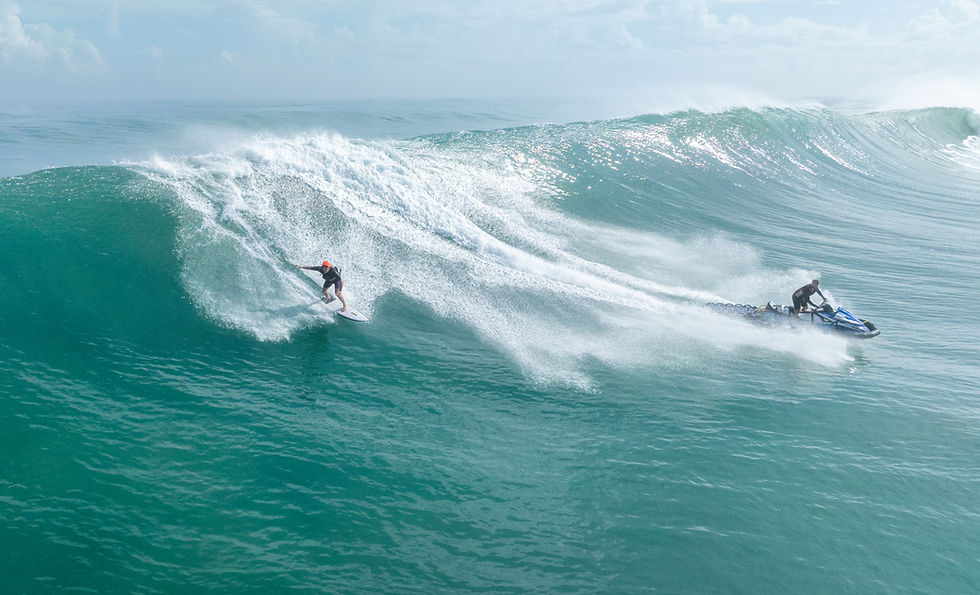
The 880's ability to turn is also astounding. While Wing surfing some waves I found the HA 880 to be loose and mimics that of rail to rail surfing which is what the MA series is phenomenal at. Riding waves is my favorite part of wing surfing. Being able to flow on a wave and maximize top to bottom surfing style reins all supreme in my opinion. So being on a foil that allows one to be deeper and more critical on a section of the wave while providing the ability to turn is magical. I tend to notice myself projecting far out on the the shoulder of the wave because of the efficiency and speed that foiling provides, but this new HA series has a way of keeping the rider connected and stable while in the pocket. This however sheds light on a characteristic on the 880.
The HA 880 is slower than what I would expect from a HA foil. Though this can be seen as an advantage while surfing because the rider gets to be more critical (deeper in the pocket) and can create better flow while surfing a wave. I also found great stability and control at high speeds while using the HA 880. Something that the MA 1000 stood above the crowd in comparison to other foil brands. Armstrong seemed to kept that same "stability at speed" in the DNA of making their newer HA series.
Now, I covered the low end lift, curving ability, speed, and stability of the HA 880, but there's one key feature I've left out... That's the HA 880's ability to pump like the best of them. Pump! Pump! Pump! It up!!! Yes, this foil loves to pump and its ability to activate at lower speeds provides forgiveness while connecting waves. At times I find it difficult to keep my speed up while pumping out the back of the wave, especially when I've turned too sharply seeking another opportunity for a ride. Luckily enough the 880 can come alive with a deep power pump followed with some fast shallow cadence pumps. I've notice with speed the HA 880 loves some quick shallow pumps to keep the flow going between the energy pockets and waves. The low end of this foil is so good that if you get off rhythm, a few power pumps can save the day.

To summarize, the HA 880 is an amazing surf foil. Its design is well thought out with even the correlation of speed management and how too much speed can be a bad thing when surfing a wave. I've never thought about it, until I was surfing this foil on a waist high day in the outer reef. After seeking speed coming off the white water, I notice how I didn't have to retreat towards the troff in order to bleed speed to project myself back mid-space on a wave. I could hit the white water and immediately project out to mid face and continue holding a line I would on a surfboard. I'm truly excited about learning how far I can push HA880 in the surf for it's a complete game changer in its approach of speed management, curve ability, and pump.
I'm not a sponsored rider for Armstrong nor did they pay me for this review in anyway. Cowabunga!
Alex Kappes with RAD Kiteboarding


SP18 Zabrze suggests a numbered primary school identity connected to Zabrze. I would be interested in the practical information a family needs before it can understand the everyday experience behind that name. That is how I think about SP18 Zabrze primary school information. Clear expectations and understandable messages can make school life easier to follow. I like information that anticipates ordinary questions instead of assuming every reader already knows the routines or the meaning of an internal school label.
The name Smyk makes me think of young children and the curiosity that appears in ordinary play. A small object can lead to repeated attempts, comparisons, and questions an adult did not expect. That is the connection I see with Smyk childhood play. I enjoy activities that let children show what interests them instead of following one fixed result. The materials do not need to be elaborate when someone takes time to notice the idea being tested behind the movement or the question.
The combination of School and ML suggests an educational angle on machine learning. I am most interested in examples that make the connection between data and a result understandable without hiding the limitations. That is what I associate with School ML machine learning. A demonstration can invite questions about what the model has learned and what the example does not show. I like explanations that leave room for those questions, because a neat result should not be mistaken for a complete account of how the tool works.
PZ3 is a short numbered identity, and I would want to know what it represents before drawing conclusions about its educational role. The name itself gives a reader a reference point rather than a complete explanation. That is why context matters to me around PZ3 education identity. I appreciate introductions that explain the audience and purpose in ordinary language. A visitor can then explore with a useful question instead of relying on an uncertain expansion of the initials.
The name Przedszkole Debno clearly points to preschool and a local identity. That makes me think about the small routines children encounter when a new day begins. I associate Przedszkole Debno preschool routines with questions about arriving, finding an activity, and understanding what happens after goodbye. A familiar sequence can be reassuring without making every child move at the same pace. I like attention to those everyday details, because a comfortable beginning can leave more room for curiosity during the rest of the day.